The Complex-Pole Filter Representation (COFRE) for Spectral Modeling of fNIRS Signals
Authors: Pinto-Orellana, Marco A. and Mirtaheri, Peyman and Hammer, Hugo L.
Abstract
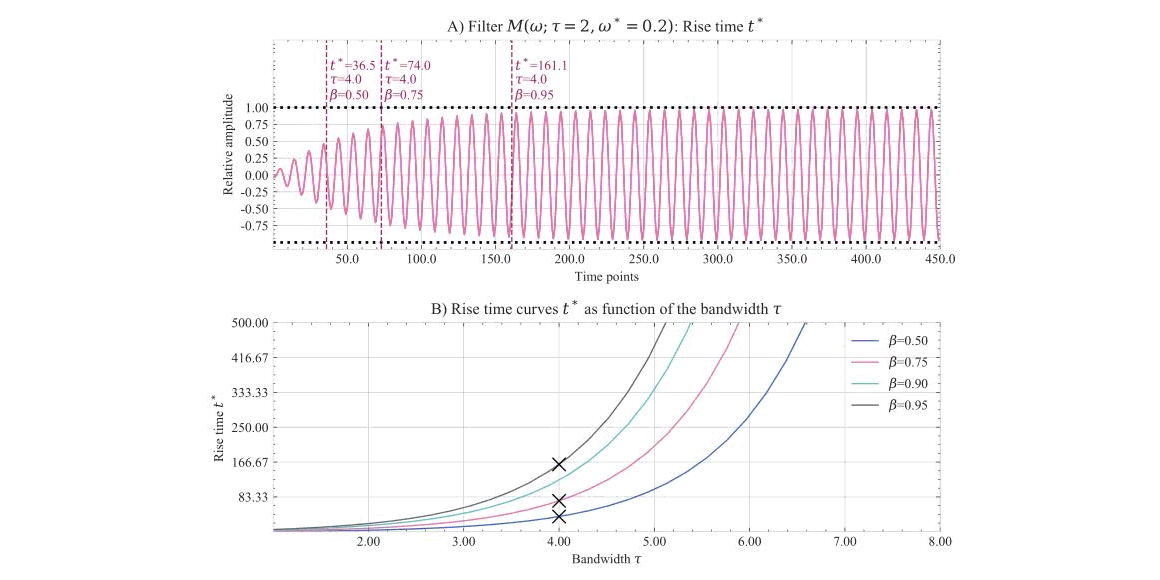
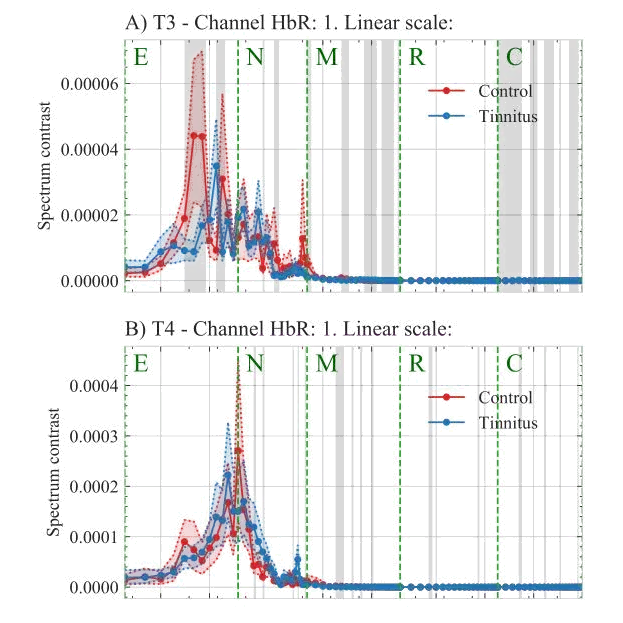
The complex-pole frequency representation (COFRE) is introduced in this paper as a new approach for spectrum modeling in biomedical signals. Our method allows us to estimate the spectral power density at precise frequencies using an array of narrow band-pass filters with single complex poles. Closed-form expressions for the frequency resolution and transient time response of the proposed filters have also been formulated. In addition, COFRE filters have a constant time and space complexity allowing their use in real-time environments. Our model was applied to identify frequency markers that characterize tinnitus in very-low-frequency oscillations within functional near-infrared spectroscopy (fNIRS) signals. We examined data from six patients with subjective tinnitus and seven healthy participants as a control group. A significant decrease in the spectrum power was observed in tinnitus patients in the left temporal lobe. In particular, we identified several tinnitus signatures in the spectral hemodynamic information, including (a.) a significant spectrum difference in one specific harmonic in the metabolic/endothelial frequency region, at 7mHz, for both chromophores and hemispheres; and (b.) a significant differences in the range 30-50mHz in the neurogenic/myogenic band.
BibTeX
@article{ComplexPoleFilterRepresentation-Pinto-Orellana-2021,
  title = {The {{Complex-Pole Filter Representation}} ({{COFRE}}) for Spectral Modeling of {{fNIRS}} Signals},
  author = {{Pinto-Orellana}, Marco A. and Mirtaheri, Peyman and Hammer, Hugo L.},
  year = {2021},
  journal = {arXiv:2105.13476 [physics, q-bio, stat]},
  eprint = {2105.13476},
  primaryclass = {physics, q-bio, stat},
  archiveprefix = {arXiv},
  keywords = {Physics - Medical Physics,Quantitative Biology - Quantitative Methods,Statistics - Methodology}
}